
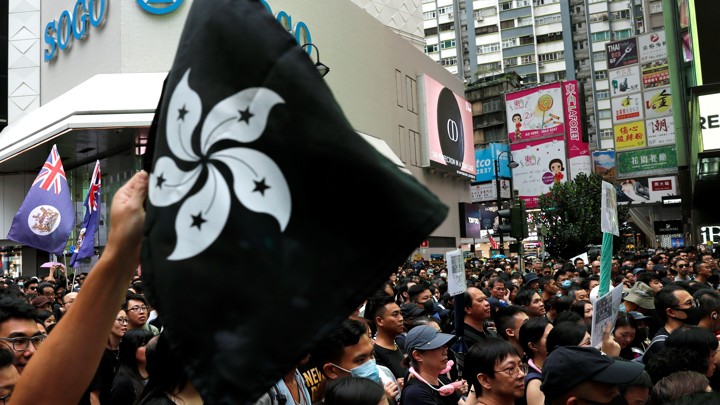
I have HK friends who cannot sit at the same table for dinner because of differing opinions on the way the protests have descended to. Even back in Malaysia, I have close friends who keep posting how the rioters should be handled, locked up and punished.
I don’t think that the majority understand fully why the protests are ongoing; why it has descended into rioting and mayhem … and many people in HK are still in support.

Anyone who is outside of HK would find it easy to question and condemn the silliness, naivety, and futility of the rioters’ efforts.
This is by no means an apologetics diatribe to justify the protesters and (maybe even) the rioters. Rather, it is an attempt to understand the thinking and makeup of most Hongkongers.
First, let’s look at why a lot of foreign people dislike the protesters/rioters:
– a complete disregard for rule of law
– the HK police force has been too ‘lenient’ and the “rules of engagement” too humanist as to limit the powers of the police to counter the protesters
– doesn’t HK belong to China anyway?
– in less than 30 years HK will go back to China whether you like it or not
– to go against Beijing is almost a truly futile effort in the end
– doesn’t HK people know how dependent their economy and business future is on China?
– there’s nothing much that HK is good at other than shipping, logistics, property (domestic) and as a financial center.
To try and blame foreign sources for funding and influencing the rioters and protesters is exactly why the local people in government and Beijing to a lesser extent fail to appreciate the depth of the discontent among the majority of HK people. Let’s put that aside and try to understand the whys’.
 |
| https://andropausesuccor.com/ |
ANGST Section 1 – Historical & Political Apathy
– most of the older people in HK now FLED China, now let that sink in a bit. FLED, past tense of FLEE. The younger folks who were born in HK only knew of their colonial master, as a dominion of the British empire
– hence we can appreciate the political apathy for much of the past 100 years, there wasn’t a call for universal suffrage because it was a British colony and to my knowledge, there was never a substantive call or formation of a movement to declare that the population wishes to form a separate country or government
– when the Brits agreed to sign back HK to China in the 1997 agreement
– on June 9, 1898, the British under Queen Victoria brokered a 99-year lease agreement for the use of Hong Kong after China lost a series of wars fought over the British trade in tea and opium
– in 1984, British Prime Minister Margaret Thatcher and Chinese Premier Zhao Ziyang negotiated the underlying plan for the lease to end, such that Hong Kong would remain a semi-autonomous region for a 50-year period after the lease ended
– the lease ended on July 1, 1997, and since then tensions between the democratically-minded Hong Kong population and the PRC have continued, although Hong Kong remains functionally separate from the Chinese mainland
– the perceived increased of Beijing influence over the past 15 years have left many HKers shaking their heads
– most HK people did not feel the need to ask for universal suffrage under the British because the latter allowed HK to flourish under the laissez-faire economic system, backed by ICAC for corruption eradication, the independence of the judiciary and legal system, and the relative independence of the police force … all hallmarks of good governance of a capitalistic economy
ANGST Section 2 – Culture/Displacement
– way too many Chinese from the mainland has been invading HK in various means: shopping, buying up properties and stocks to start with
– thousand of kids from southern China take the long train ride to go to schools in HK, causing a strain on resources and places for HK kids
– the mass buying of baby powder and a plethora of other stuff to trade back in China
– the huge surge in the number of Chinese women from the mainland to have their babies in HK, straining resources and places further
– these are more than just tourists’ troubling behaviour; it is considered intolerable to the extent that HK’s culture is being eroded, their rights and privileges are also being eroded, their home is no longer the home they were used to, HK is more dependent on Mandarin in a way that is unsettling for most, and most ironically most HK people no longer can afford to live in HK while many of the rich mainland Chinese can and do so with aplomb.
ANGST Section 3 – Affordability Gap
– unless you already paid-up on your unit in HK, you are basically the majority of them striving to carve out 60-70% of their monthly pay for the mortgage or to save enough for a down payment
– even you daily existence is paying homage and duties to the landlords via higher rents, higher food prices, higher everything really because rents, space, and buildings are all owned by the elite few and cost more than an arm and a leg
– the cosy relationship between the ruling elite and property barons has led to a stifled release of land for public housing over the past 30 years; is it a wonder that more than 70% of HK land has been gazetted as reserves (for environmental protection, or other altruistic reasons) … I am all for being green but not when the majority of your citizens are suffering indirectly due to these political moves
– despite years of schooling and using loads of funds for education, many of the youths find the future bleak – rising costs and property affordability gap and lack of freedom, all were a recipe for an uprising … mixed that in with undisguised contempt for the influx of mainland Chinese into many things in HK, you have a fire morphing into a fireball
– Hong Kong has also set world records in home prices and has a glaring income gap. In 2016, it had a Gini coefficient – a measure of inequality – of 0.539, which Oxfam said was the highest in 45 years.
ANGST Section 4 – Trust Deficit With Beijing
– remember that the bulk of HKers were made up people who chose to flee to HK, now you want them to go back to be governed by the motherland
– while Beijing does a lot of things well, it has a very different way of doing things when it comes to dissent, political opinions that differ from the “official stance” … and that translates itself to overbearing laws for “control” purposes and to stifle and the lines of control from the courts to the police to the army act as one machinery for the good of the party (I mean, how to trust a state prosecution process that has a 99% conviction rate??!!)
– the Legco was set up as a mouthpiece for Beijing, even though some seats were available for election by the masses, the entire setup was such that there was no way to overthrow or even pass legislation without Beijing’s approval
– the extradition bill was just the straw that broke the camel’s back, hence even when the bill was finally withdrawn and killed off, it was too late to stop the protests.
ANGST Section 5 – Trust Deficit With Local Government
– In many ways, the distrust with local government is greater than with Beijing although both are similar in the eyes of most HKers
– By being appointed, and by inference cosying up to the richest in HK and Beijing, the entire Legco has to go
 |
| https://andropausesuccor.com/ |
– for those who say the protesters could have gone about their protests in the proper way… that is exactly the point of protests breaking out into riots, there is no way for any “voices” to be heard or to lead to substantive changes in the current political ecosystem.
A WAY OUT? – HK is important to Beijing but not as important as say 20 years ago. There is no way for Beijing to grant independence, even the protesters know that. But why force a group of people to be back into your system when they clearly don’t want your ways.
If I was Beijing, I would extend the 50 year agreement of two systems to 100 years. Next, I would revamp Legco to allow for absolute universal suffrage. To have 100% seats being elected by the people. Much like a federal government and a state government structure. Absolute no question on wanting independence will be tolerated.




 thestarmalaysia.news.blog