Mahathir’s plan B


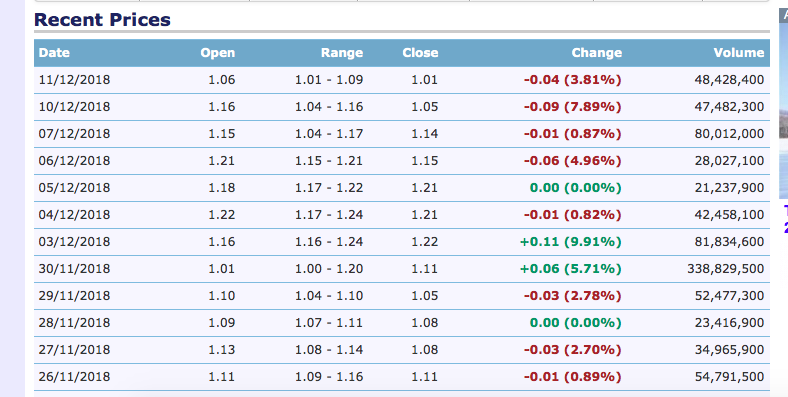
Investors, traders and fund managers have been scratching their heads over the past week over MyEG’s share price. Just have a look:
“The company wishes to inform that to the best of its knowledge after making due enquiry with the board of directors and major shareholders of the company seeking the cause of the unusual market activity in the company’s securities, the company is not aware of any factor which may have contributed to the unusual market activity, which led to the sharp fall in share price and increase in volume recently,” it said.
Read more at https://www.thestar.com.my/business/business-news/2018/12/12/my-eg-falls-in-heavy-trade/#5V4hMkcGk4IJr6JL.99
Generally i wouldn’t bat an eyelid over stock volatility, especially in the present trying market conditions. What was galling was that the official statement from the company itself that they did not know why the stock price got hammered over the past few days.
Let’s look at the developments over the past few days:
a) There was an immense volume jump on 30 November to 338.8m shares with the majority of the shares “crossed in the market” at RM1.11 during the “price fixing slot (4.45-4.50pm)”. Crossing in the market hints of legitimacy and also can shroud the real seller and buyer if they did it via numerous accounts. As no substantial shareholder informed Bursa that they had bought/sold substantially a few days after that transaction, suffice to say, they came from various sources of buyers and sellers – but it would be clear to any market observer that tens of accounts cannot be acting in concert without “someone in control of the situation”.
338.8m shares a day is almost 10% of its number of shares outstanding. That amount of shares being traded, with the bulk at 4.50pm all in one go. Hard t fathom that it was all minority shareholders deciding to sell and buy all at once.
b) The stock traded up 11 sen on 81.8m shares the next day but subsequently has been falling like a rock continuously till the big drop today: down 17 sen to close at the day’s low of 84 sen on 231.8m shares traded.
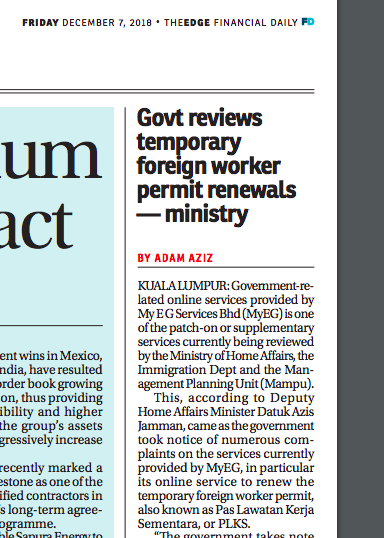
c) The government announced on 7 December that it is reviewing temporary foreign worker permit renewals, which affected MyEG’s business outlook for sure if they were to lose the business.
Hence one of the first question will be: “did the sellers knew of this news on 30 November?”
It would be too simplistic to think the sellers knew something that they buyer doesn’t. In many collusion cases, both sellers and buyers KNOW about the impending market moving news. Sometimes the “sellers” are more important, and need to sell first without people knowing. The buyers then sell again in the market later. I am just guessing here. Or it may be NOBODY knows anything and it was a straight forward market transaction. Anyhow, Bursa and SC should investigate so as to provide all investors with a clear picture that nothing untoward actually happened. It is important for market integrity.
d) Even more interesting was that on 27 November, the company announced potential e-govt projects in Indonesia. This can be surmised as positive news as it might be able to transplant similar business model and business knowledge in a less “politically motivated” environment.
e) If the 7 December news was “so bad”, the selldown would have happened immediately, but no, it did not.
f) So was it a margin shortfall situation like Seacera. Possible but we don’t know. Judging by the flow of events, a margin sell down by a substantial shareholder could be probable, and if that’s the case the company should not say they don’t know what happened.
g) The company and TS Wong have been busy buying shares for the past few weeks. I am going to leave the facts there. EPF announced on 12 December that it is now a new substantial shareholder with in that they have acquired 29.5m shares. Doesn’t look too good for EPF to have bought and see the stock crater the next day.
Conclusion: I am not saying there were any shenanigans over the last 2 weeks but for the company to say they were unaware is a bit hard to stomach.


Najib and Rosmah’s people are seeking help to bring back RM2 billion for reason unknown.
Najib and Rosmah’s people are seeking the Open Society to bring back RM2 billion.

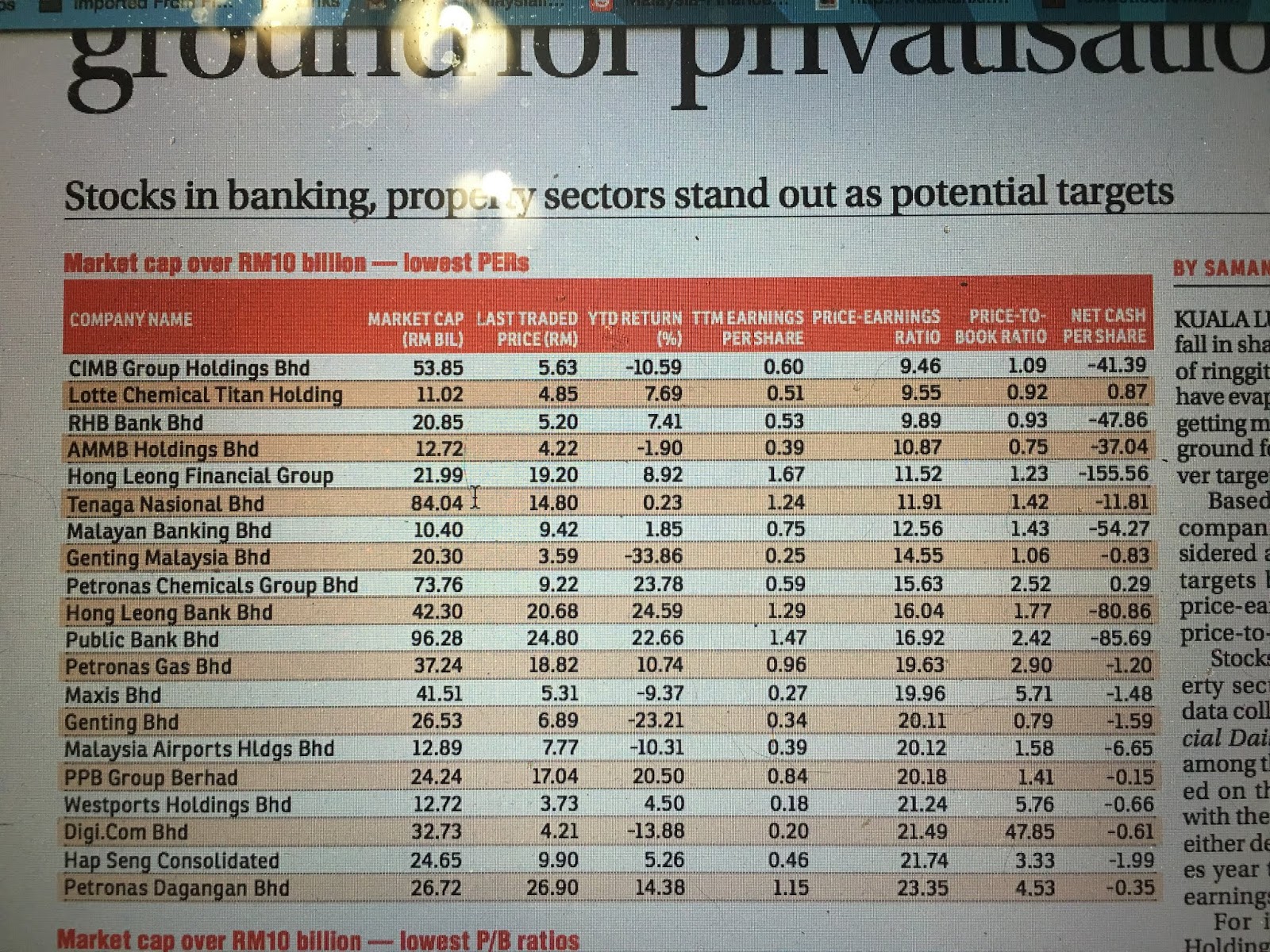
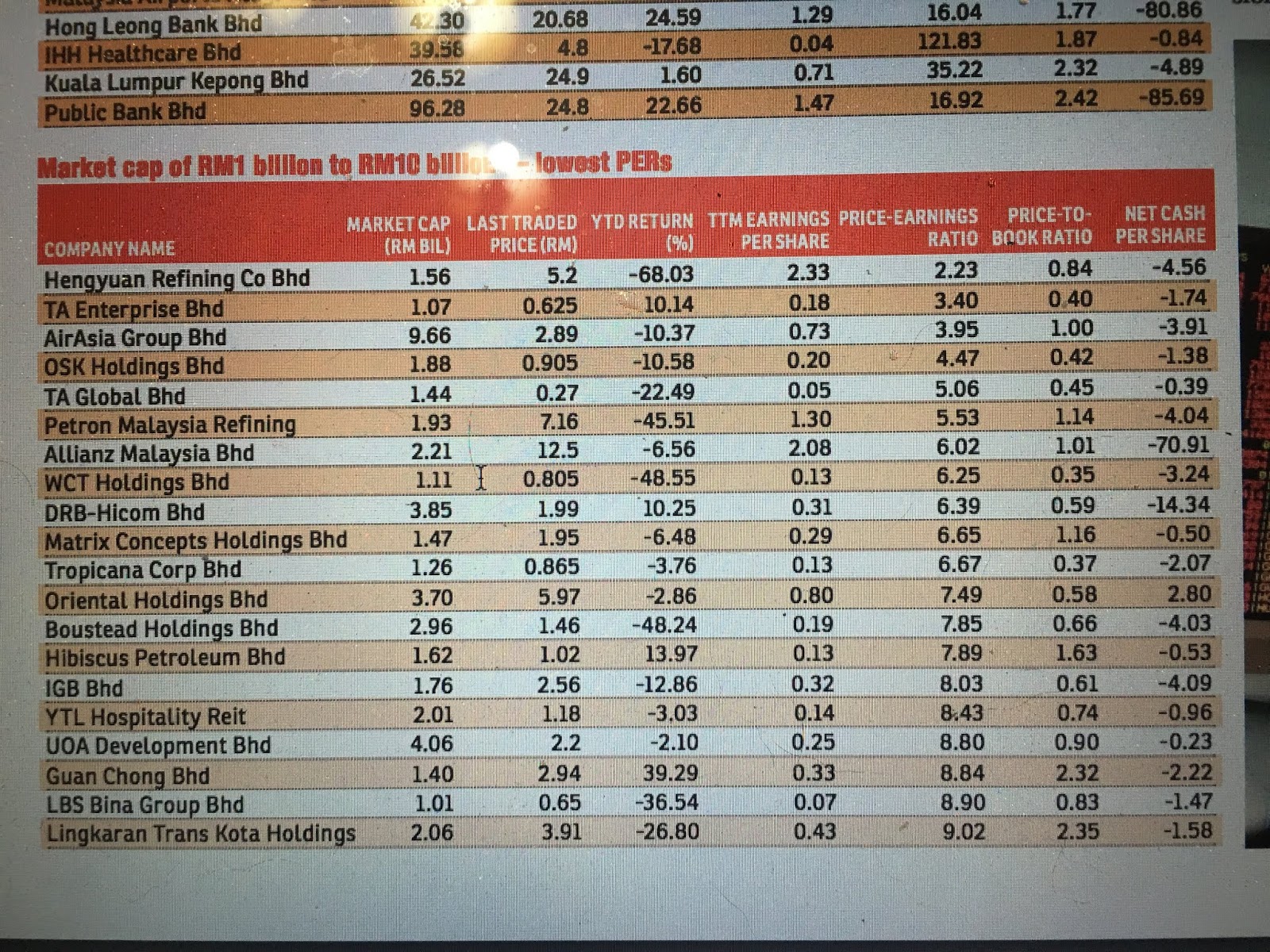
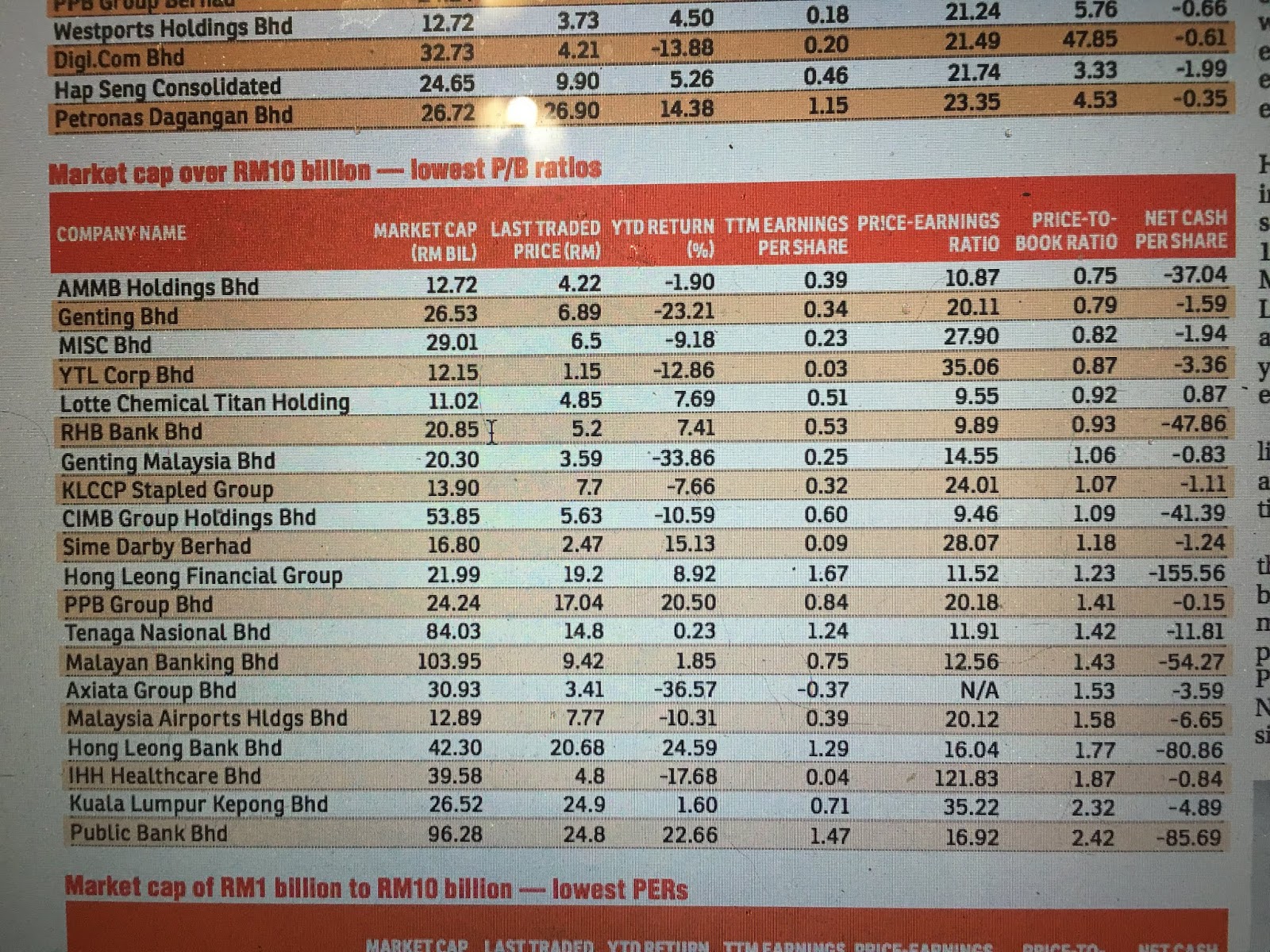
The Edge did a marvellous compilation on stocks with low PER and low P/B, citing considerations that there may be plenty of opportunities for privatisation. Let’s look at the low PER first.
Granted the equity markets have been in the doldrums for sometime now, hence as a collective group PER valuations would move down. It has to do with what we call “earnings visibility”.
Privatisation is seemingly easy to suggests but the reality for most listed companies, even when their PER or PB are low, they needed the access to capital markets via their listing vehicle. Hence to take them private be it the owners themselves or PE funds, they probably have to tag another extra 30% as capital needs as each privatisation will need to wait it out maybe 3-5 years before relisting.
PER SECTION
a) PER refers to the earnings ratio. Hence there are a few assumptions, PER is only a valid reading if its a “going concern”. PER has to do with earnings predictability. How low is deemed as low? Well it varies according to the industry they are in.
Product life – Easy to explain if its steel products or oil palm earnings, the paradigm rarely shifts much. Even when its cyclical one can argue that it is predictable as the four seasons. However, some products, esp technology based, require reinvention and R&D spending cause products can be obsolete within a shorter cycle (3-5 years). Which is why every new I Phone will hit share price of Apple up or down every 2-4 years.
Predictable Margins – This should be the most important factor for high/low PER. If you are capital intensive (steel) your margins are going to be low, which partly explains a lower PER range. Same for tech companies which should command higher margins and as such higher range of PER.
Thus we cannot say just shoot for the 5 lowest PER stocks for investing purposes or prvatisation.
b) The Banks – The banks are quite attractively priced in terms of PER now compared to historical range. Earnings is clouded becaus enothing much is moving. Equity markets very slow, investment banking very slow, property loans even slower. But thats the present and the immediate future (1-2 years out). If you are considering as a long term investment, banks look good, if you want a proxy on a recovery in 2-3 years, banks would be excellent. Its not like any of the top few are losing money.
Should you privatise then? It takes a hefty sum to privatise plus tack in another 2% in fees. Then most probably you need to relist, which might take 3-4 years out in this scenario to get a better valuation. Plus the valuation then must be lucrative enough (e.g. maybe in the 30-40% range). Can we relist CIMB in 3 years at 15x, maybe.
But the biggest obstacle in the period when it is privatised, as banks are capital hungry vehicles. Can the funder also fund the capital requirements. Which is why banks are usually out of the question when it comes to privatisation opportunities.
c) Genting Malaysia – Hit very hard by higher duties and taxes in the recent Budget, and got hit again by the Disney/Fox legal issue. Investors must be very careful to use historical prices and PER for Genting Malaysia to base their investing decisions. The whole earnings structure, in particular margins, have shifted substantively. The previous high will be insurmountable in today’s rules.
GM will earn a lot less for every ringgit. The upside is that now GM is highly uncompetitive in the region – in that the government would have very little room to further raise taxes and duties on GM in the future. Now that it second in the region in terms of duties and taxes.
So, another no-go candidate for privatisaton. Share price will have to hit RM2.50 before the Lim family should do any serious privatisation considerations.
The rest in the first table still have exceedingly high PER valuations, e.g. Maxis, Westport, DIGI.
The auto makers, brokers, insurance and property counters are about there, and nothing terribly exciting, no one will be thinking of privatisation.
f) Stocks like Mulpha or TA Global, nobody really knows what they want to do or are doing. They might not do much over the next 10 years. No point looking at them. You get charkuayteow at 20 sen a plate also no use as the horfun is made of plastic.
g) Politically Out Of Favour – Without needing to name names, they should be forgotten in the new era, earnings visibility ZERO.
h) Paramount Corp – At 10x, looking very interesting but I think it needs to get to 7x before they will act.
P/B SECTION
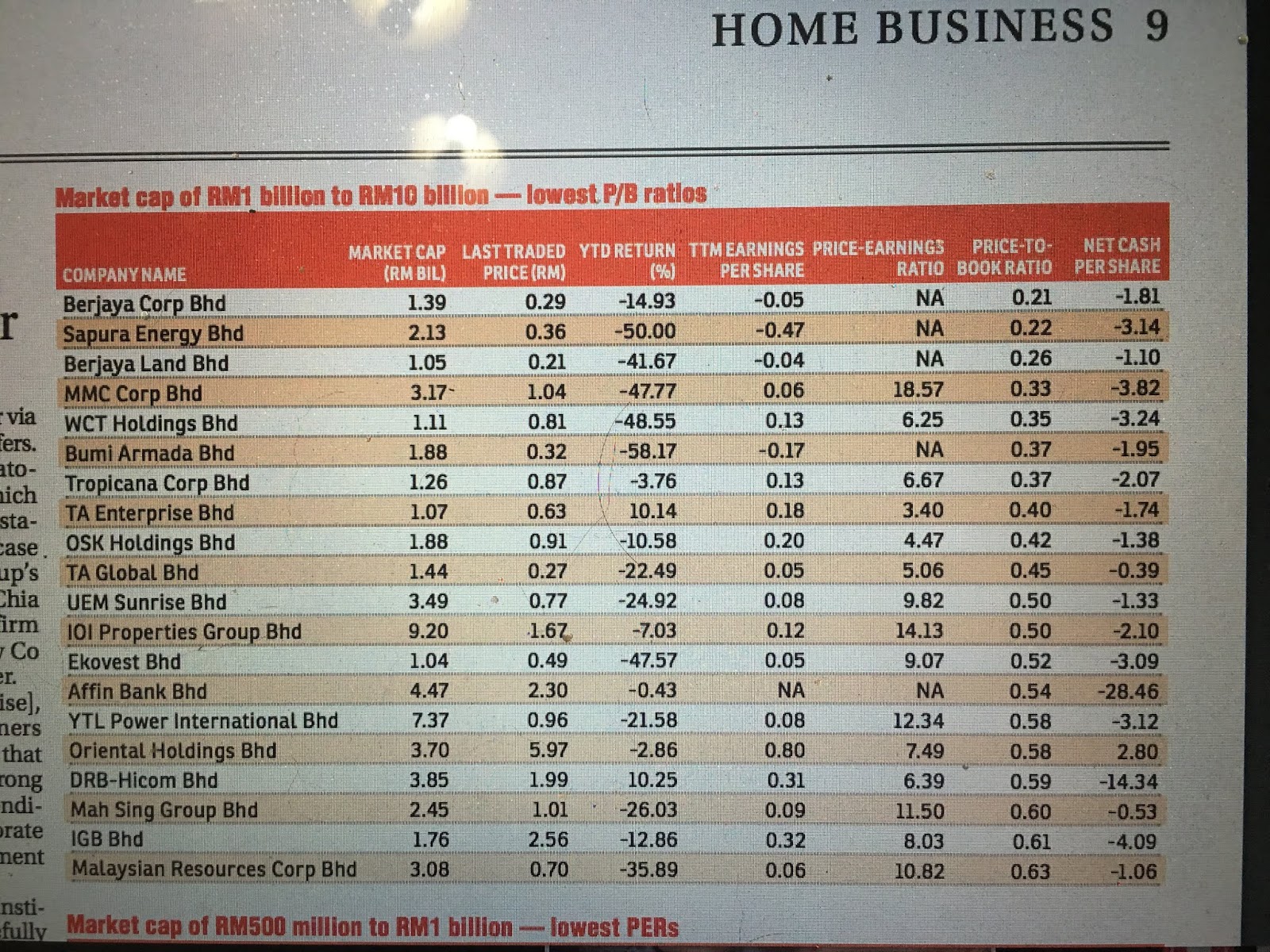
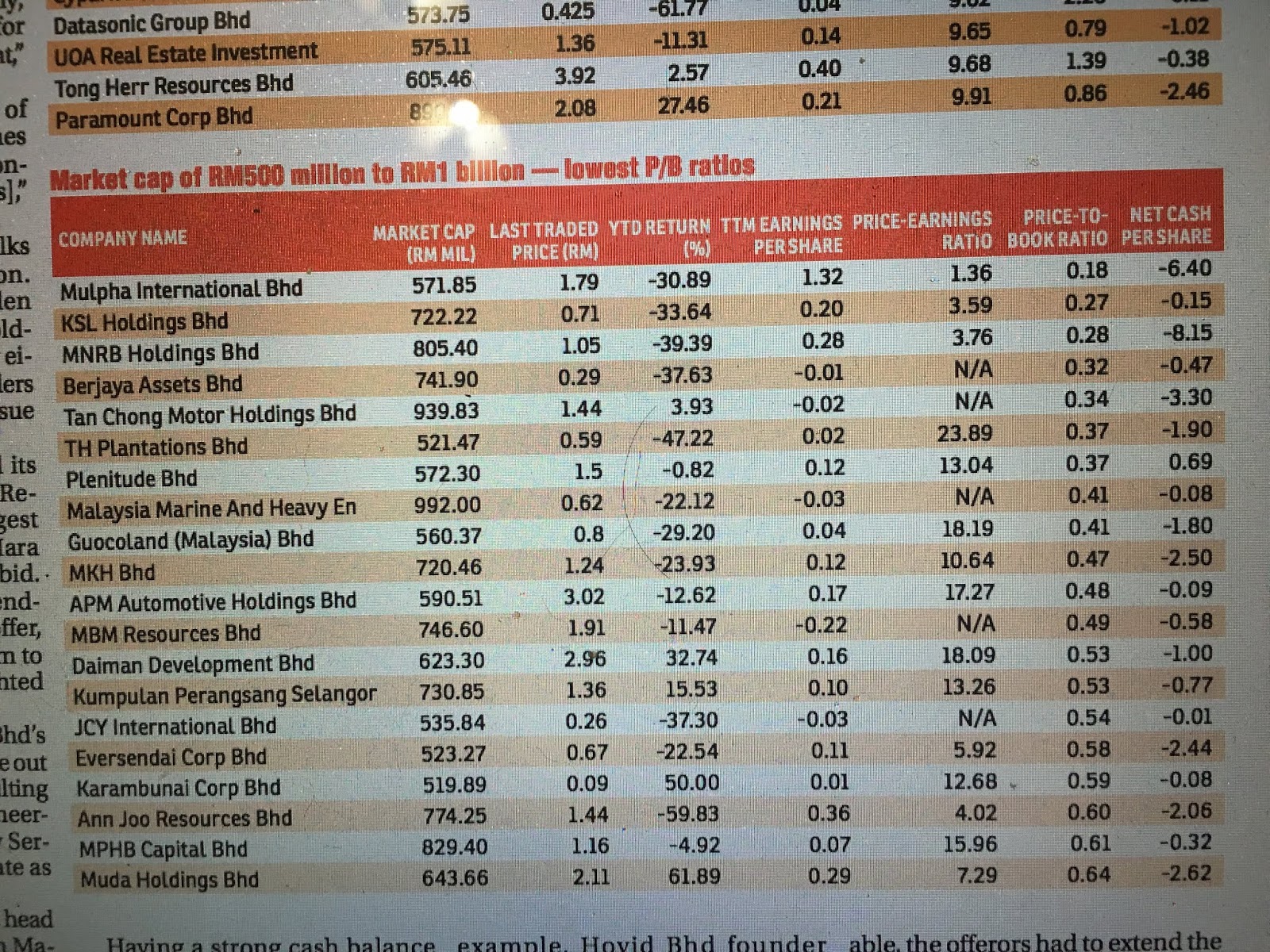
P/B is a low confort investment factor. P/B is only relevant IF the company is bundled up and sold in pieces or as a whole. Too many vehicles have too many local funds and government interest involved that they won’t be sold even if Blackrock makes an attractive offer.
a) KLCCP Stapled – PB at 1.07x. This one is interesting because we are talking about the creme de la creme of property REIT. Highly desirable if it drop to 0.95x.
b) Owner Driven – Many of these owner driven counters have shocking low PB. Well, if the owner also don’t want to privatise at 0.3x, why would you want them? The exception maybe is Tropicana Corp, which has astutely offloaded a lot of Johor land last couple of years. Tropicana with a PB 0.37 has reached a level that makes it highly attractive to privatise.
Some of the property companies has a low Pb ratio too but you have to assess how “realisable the bulk of the assets (land bank) are”.

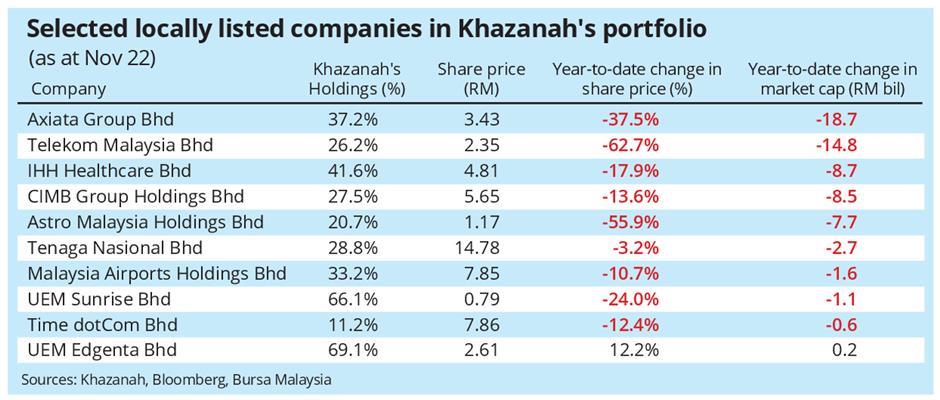
Khazanah’s portfolio makes for a very interesting read, but probably not for the reasons you are thinking. Yes, the markets have been bad. It would have been a very cheap shot to snap a portfolio’s performance at ONE specific date and try to “shame” the managers. That is not my intent and I don’t think Star Biz wanted to do that at all.
a) Performance – It is in line with the rout in global equity markets, more so for emerging or developing markets. The trade war exacerbated the situation.
b) Key Holdings – Mind you, these are key holdings, or substantive holdings of the said company, hence it is not like you can trade in and out easily.
c) Blame – Well, even in a rout you have losers and real outsized losers. Could Khazanah have known or impacted on those companies. We are talking about Axiata, Telekom and Astro in particular? They could only make their input at board level. Failing which, they could have initiated a replacement of the CEO with someone with a better strategy and execution ability to navigate the changing landscape or difficulties within operations. On that level, yes, some blame could be attributed to Khazanah.
d) In Line – The rest, the losses were understandable and in line. Even UEM Sunrise would have a down trodden property market to help explain its performance.
e) Crowding Out Effect – Curiously, the best lesson to be learned from the table is the crowding out effect, or lack of rather. I used to hammer home the point that the big danger for Malaysian equity market is that local funds are getting much too much funds flow, and together they keep holding an increasingly larger and larger slice of the ownership of key index component stocks.
The follow on thesis is that at a very substantive level, the local funds may be able to “control” prices of selected stocks which would then give an unfair picture of the true worth of their holdings. If retailers and foreigners keep selling, and local funds keep buying, technically prices wouldn’t change. But the table above showed clearly that NONE of that is happening – which is a good thing.
Conclusions: Khazanah, and other local funds which hold substantial stakes in listed firms, must be more proactive and vigilant in assessing the direction, strategy and operations of the said companies. Questions need to be asked more frequently whether they are aware and prepared for the forever changing competitive landscape and shifting economic paradigm they are operating in.
In my view, too often the CEOs of GLC linked firms are given too wide a berth to manage the companies. Are they mere messengers to comply or are they active agents for change and improvements? The hiring and firing must be swifter. You dilly-dally you get FGV.
On that note, EPF has a brewing problem at RHB Bank. The rapid departure of many key staff did not happen just the last few months. You can trace it back as far as two years but NOTHING changed. As a cursory member of the financial industry, one can see that there are huge problems at RHB. Anecdotal hearsay: too many decisions done by committees, HR is the most powerful department there (not in a good way), the old guard act like gatekeepers and not many are keen to stick their necks out for taking on more risks. Only now we are talking about changing CEO. In my view, not just the CEO but probably another 10 top people there needed to go as well.

Mahathir is holding the cards close to his chest for the coming reshuffle.
WILL THERE BE SURPRISES OR SHOCK WAVE THAT CAN ROCK THE NATION?
But like most Malaysians after PKR election, we know Mahathir will as usual change his Deputy to someone who promised to make Mukriz the future Prime Minister.
The fact that Anwar already said he does not want the Deputy Prime Minister post but the Prime Minister seat make it easier for Mahathir to replace Kak Wan with Azmin Ali.
Mahathir today and the past are the same except in age when it comes to the issue of Anwar.
Now that the main cast is put in place, who then will be move?
Two have been given a year to live so they have to go.
One being kicked out from the State.
Two make a mockery of their position as Ministers.
One who can only work if given a title.
One who demand for 30% commission on every task given by her Ministry.
One who could not sell our bonds and bring in investment.
SO WHO ARE THE LUCKY ONES IN THIS GAME OF CHESS?

In Malaysia it is hard to find a caring leader who can lead with honest heart and open mind.
This happens about 2 to 3 times a year, in China. It is always either the Koreans or Japanese. Sometimes its the Americans, now its Dolce & Gabbana. Every time something is not right or not nice happens to China, usually corporate wise, the said country’s products will be boycotted. Sometimes it can happen via tourism where they vote with their feet. You get angry at MAS, you will stop coming to Malaysia. You did not do rescue operations well in Thailand, I will not go there.
Its like a belligerent child getting his/her way with the parents’ approval.
China needs to understand and its citizens need to understand – people make mistakes, companies make mistakes …how would you like it if a Chinese citizen in Hubei ranted off on FB racist comments about “pick any country”. Does it make sense then to boycott all Chinese products? Come on, grow up.
Deal with each instance properly. Just because you are the world’s biggest consumer group does not mean you use that as leverage every time you go crybaby. Be angry at the issue or the person, but not put the whole country’s products at risk. One person’s action is not representative of the whole company. One company’s action is not representative of the entire country.
You behave as if China does NO WRONG. Just grow up if you want to be a citizen of the world. If you do not like the policies of ANOTHER COUNTRY, deal with it diplomatically. Not by asking your citizens to boycott that country. Just because you are the biggest kid in class does not give you the right to be a bully. Because you know very well the smaller countries cannot do likewise. If thats not bullying I don’t know what is.
The thing is not all Chinese citizens feel the same way, some are more mature and may not feel the same way, but they will also feel the pressure to conform. Just ask the celebs who pulled out of the D&G contracts. Plus most foreign products in China are usually joint ventures and employ a lot of Chinese anyway, you end up hurting your own.
It is up to Beijing to to defuse and come up with a better plan to deal with such events and crises. Everyone looks to the parent. Teach them well to be better global citizens.
Ever wondered why there are so many untoward incidents by Chinese tourists overseas (refusing to leave plane; highly agitated protests by travel groups at airports; etc.). Its the comfort that Beijing will look after them, its the Wolf Warrior 2 movies that preaches ultra patriotism and nationalism that the country will cover you in everything… and when the country practices “bullying” whenever things are not right or they feel slighted, everybody think its okay when they do it on their own accord.
The boycott policy can lead to a lot of negative behaviour. Everything need not end in a large scale protest. The age for China’s wallet diplomacy is over, or rather should be over.
~~~~~~~~~~~~~~~~~~~~~~~~~~~~~~~~~~
The founders of the Italian fashion label Dolce & Gabbana have issued an apology to the Chinese people after a growing backlash over Stefano Gabbana’s “racist outburst”. The fashion house has faced intense anger after an Instagram conversation in which Gabbana described China as a “country of s***” was leaked.
~~~~~~~~~~~~~~~~~~~~~~~~~~~~~~~~~~~~~~~~~~~~~~~~~~~~~~
The pattern was similar for the 2012 boycott of Japanese products. Kilian Heilmann, a researcher at the University of California, San Diego, found that Japanese car exports to China tumbled 32 per cent, or $1.9bn, in the 12 months after the boycott launched in September 2012 in response to Tokyo’s purchase of disputed islands known as the Diaoyu in China and Senkaku in Japan.

When Malaysia became independent in 1957, we had people of foreign origin … but we accepted all of them. They are now citizens, they play a full role in the politics of the country, they are free, they are not detained because of race or anything like that.

Today mark a very sad and negative day for all born in Malaysia.
Today the extremist Malay group once again won their battle against the minority Malaysians.
To develop and be happy in Malaysia is no longer true.
Though Malaysians have changed the Government, the people elected into power do not serve the people.
Today shows the Malaysian Government is weak and dishonest.
So what is so different from the old Government and the new one?
THE ANSWER IS NONE.
Malaysians who have chosen the wrong people into power deserve this punishment.
https://www.freemalaysiatoday.com/category/nation/2018/11/23/putrajaya-says-no-to-icerd/