Retailers in tourist zones record over 70% slump in sales amid coronavirus outbreak

At least two retailers are experiencing drastic sales decline at their outlets located at tourist zones, following concerns over the 2019 novel coronavirus (Covid-19) outbreak.

A spokesperson at Bonia Corp Bhd said sales of its Bonia branded goods have fallen significantly, and by as much as 77% in at least one location.

“The coronavirus outbreak has hit the Malaysian retail business…In the first 17 days of February, sales have dropped by 30% overall (for the Bonia brand), compared to the same period last year,” a Bonia spokesperson told theedgemarkets.com.

“Our Genting Highlands outlet has been tremendously affected,” he said, adding sales at SkyAvenue, Genting Highlands — where its shoppers are mostly from China, Hong Kong and Indonesia — has dropped by a steep 77% compared to last year. Other outlets that have suffered include the one in Pavilion Kuala Lumpur, where sales have fallen by 35% compared to last year.

“The key factor is Covid-19, which has made tourists numbers decline, while local consumers are shying away from crowded malls during their weekend outings,” he added.

He added that other tourist-zone outlets that have been severely affected are those in Johor including the ones located at Johor Premium Outlet, City Square and Aeon Tebrau City. He said the majority of shoppers in Johor, who are usually Indonesian tourists who go to these outlets via Singapore, are no longer coming.

The group’s stores in Penang are similarly affected, he said, adding Bonia expects its overall sales to remain depressed up until March.

Apart from Bonia, the group’s retail brands include Sembonia, Braun Buffel and licenced brands such as Valentino Rudy, Renoma and Santa Barbara. The Bonia brand accounts for 40% of its total sales.

Likewise, Datuk Nelson Kwok, the founder of Nelson’s Corn In a Cup, said his business has also been affected — particularly the ones located at public places of attractions.

“Sales is down by between 15% and 40%,” he told theedgemarkets.com, adding its worst-hit outlet is at Zoo Negara.

“We have been operating at the zoo for over 10 years. Never before in history have we only sold one cup of corn in a day,” he said. A typical weekend sees between 200 and 300 cups of corn-in-a-cup sold, he said, while weekdays usually record sales of between 50 and 60 cups.

The drastic sales decline clearly indicates that the problem is not only due to the traditional slowdown seen after the festive period. It may also be a signal that the government has to step in to help.
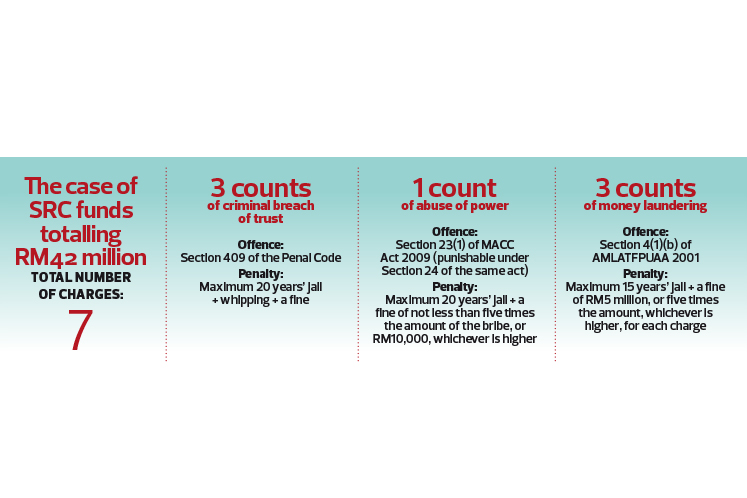

Najib’s SRC trial: Not wanting to be beholden to corporates, Najib preferred Saudi ‘donations’

BETWEEN taking political donations from Malaysian corporates and Saudi Arabia, former prime minister Datuk Seri Najib Razak told the court last week that he preferred the latter, ostensibly in the belief that he would be less beholden to a foreign nation, even though the amounts accepted were huge by any standard.

“For the general election, I wanted to be financially independent. I should not and we should not be beholden to corporate sponsorship, although it is within the ambit of the law,” he said during re-examination by his lawyer, Harvinderjit Singh.

Najib purportedly received a total of US$800 million in early 2013 from the late King Abdullah ibn Abdul Aziz Al-Saud, a donation he maintains that was given to him “to ensure the continuity” of his Barisan Nasional coalition government, or one that was indirectly meant to fund the 13th general election.

Najib claimed that King Abdullah was impressed with his leadership, Malaysia’s moderate practice of Islam and the harmony between Muslims and non-Muslims in the country.

According to Najib, the Saudis are also particularly generous in supporting Muslim countries around the world.

Still, his claims of an US$800 million donation from King Abdullah have never been confirmed in black and white. In April 2016, Saudi foreign minister Adel Ahmed Al-Jubeir confirmed the donation, but towards the end of 2018, he backtracked on his earlier comments and clarified that the funds had nothing to do with the Saudi Arabian government.

The prosecution contends that the donation was sent via a series of transactions from Tanore Finance Corp into Najib’s AmBank account.

Following the conclusion of the general election on May 5, 2013, Najib had returned the unused portion of the donation of some US$620 million to the donor as a gesture of good faith, he said, “before it became an issue”.

Najib explained he was not comfortable with such a large sum of money lying in his account and knew that the issue of confidentiality would arise. Moreover, he did not want the donation to be made public to avoid “misconceptions”.

“The Saudis support other governments around the world and they continue to do so. Nothing was out of context,” he said.

While the Tanore account has since been linked to fugitive financier Low Taek Jho, better known as Jho Low, Najib said he believed that the money had indeed come from Saudi royalty, pointing to letters confirming the donation from the Saudis.

The letters are also a point of contention as prosecutor Datuk V Sithambaram had previously put to him that the copies of the letters that Najib had produced were forged. Najib disagreed with the assertion but no one else has stepped forward to confirm their authenticity.

Asked by the prosecution if the funds had been used to buy votes, Najib replied, “I don’t want the sense of owing gratitude to anyone. The donation could fulfil our party’s requirements. It doesn’t include vote-buying, but includes events that we hold and the billboards, for example.

“It was important and also a relief that I could call on this source of donation, as opposed to corporate figures, which I admit, was the practice before. I wasn’t doing anything different from what my predecessors had done.”

While he claimed that he would prefer to not resort to political funding by corporates, Yayasan Rakyat 1Malaysia (YR1M), a foundation involved in corporate social responsibility projects, had relied on corporate funds for so-called social programmes.

In July last year, former YR1M chief executive Ung Su Ling testified that the foundation received RM230 million from Genting Group, which was used to fund social programmes and projects.

The foundation also received RM210 million and RM3 million from 1Malaysia Development Bhd and Petroliam Nasional Bhd respectively.

Najib’s argument that he would be more independent by relying on foreign donations to fund his party’s campaigning aside, most democratic countries have banned the practice over concerns of foreign interference in elections.

The trial continues on Monday before Justice Mohd Nazlan Mohd Ghazali.

Destini inks HoAs to lease out vessels, develop power generators

Destini Bhd announced today that it has entered into two agreements with Indonesia-based companies for the leasing of its vessel and to develop power units that can be placed on barges.

In one filing, Destini said its wholly-owned unit Destini Armada Pte Ltd has inked a Heads of Agreement (HoA) with PT Bahtera Sentosa Bersama (BSB).

The HoA is for the parties to enter into an agreement for BSB to lease vessels from Destini for seven years before purchasing them.

In another HoA with PT Semi Power Sistem (SPS), Destini Armada intends to establish a joint venture with the former to manufacture power plants that can be placed on barges.

Both Destini and SPS will look into developing the necessary design, detailed design engineering and manufacturing of barge power plants, said Destini.

Shares in Destini slid one sen or 4.76% to close at 20 sen today, giving it a market capitalisation of RM246.05 million.

Design a site like this with WordPress.com
Get started